Pages

Contributors

My professional profile on Linkedin

View James Alexander's profile on LinkedIn

Where my visitors are

A380's TRENT XWB

Materials Science and Engineering, Durable Development, Recycling..

Custom Search

Blog List-Free Science and Engineering Information Resources cf also Side and Bottom menu bars

Scientific Reports - nature.com science feeds

Physical sciences : nature.com subject feeds

Materials science : nature.com subject feeds

Showing posts with label Materials. Show all posts

Saturday, 29 September 2012

Sustainable Materials_with both eyes open_Free to download and read or to buy as hard cover_

Indispensable addition to  today's Materials Professionals and Designers Library.

This excellent book may be read for free at the following link

   Download the whole book in one PDF file [25Mb] 

Reviews may be found both on the book's website above, on the MaterialsToday site where I found reference to this excellent addition to the professional metallurgist, materials scientist and all involved in materials. Further this stimulated my memory as a regular reader of books reviewed by our professional materials scientists, technologists and engineers, members of The Institute- IOM3. Indeed I found  "Sustainable Materials_with both eyes open" reviewed for the Institute by Ian J. Bowbrick, (FIMMM)  Head of Professional Formation at The Royal Academy of Engineering

Executive summary by Ian who noted this book 10/10 which is an unusually high score.

"The story concludes by looking at the role business policymakers and individuals have in creating a sustainable materials future. The approach in ‘taking the fight’ to business is deftly handled. Realistically the authors cite that cost savings are too weak a driver for action by business and call on policymakers to kick-start the actions required. To this end, they propose a robust and detailed five-point plan. The story finishes with a useful pro-forma checklist for professionals looking to make a difference. 

I found this book to be well researched with reasoned and compelling arguments. Allwood and Cullen are to be congratulated on delivering a methodology that can be regarded as a paradigm shift to a new way of teaching and understanding materials science in the post-fossil fuel era society is now entering. This is essential reading for both student and practitioner, particularly those in senior management positions. 10/10." 

NB. For a full list of book reviews by IOM3 professionals all fully available to the interested specialist, non-member or motivated general public here is the

Hope you have and enjoyable and profitable read.

Thursday, 3 May 2012

Rare Earth Overview Supply Chain and Price: “Cradle to Grave” the Whole Life Cycle Approach


Critical mass -rare earth elements." 01 January 12, Materials World Magazine -Members only feature- by Prof. Animesh Jha’s is an excellent succinct overview of the wide and complex fields involving Rare Earth Elements,(REE’s)  Jha provides pointers and answers to many aspects in his near “cradle to grave” approach.


The issues at hand


“There are constant warnings about the risks of exhausting supply of vital resources, including the impact on our way of life. Professor Animesh Jha, from the Institute for Materials Research at the University of Leeds, UK, examines the sources of rare earth elements and the research driving their use in emerging technologies.” 


Prof. A. Jha provides pointers and answers to the following 5W’s type questions
on REE:

What they are, why they are important and to whom, what is global demand now and in the future (when), past present and future price evolution, based upon recent results and sustainability consideration in terms of resources and competition for energy, renewable energy.  


What they are: Fig1 below shows their position in the periodic table of elements (interactive memory refresher link)


Fig2 RHS. shows the relative abundance in the earths crust (not the ease of  economical exploration and mining)


MORE ADVANCED_FUNDAMENTAL STRUCTURES:- 

-Electron Configuration               Nuclear Structures.

Why they are important and to whom
                       -Motivation for Change and Innovation.

Prof. Jha focuses our attention on the essential role played by REE in a modern sustainable economy, quote: ”The REE supply chain (directly) affects three main sectors of the world economy – 1.energy, 2. health, and 3. digital and indirectly via 1 and 2 impacts upon the natural and built environments, and therefore on long-term climate change.” A powerful motor for growth is: “the world’s desire for developing cleaner and more energy efficient magnetic and electronic devices, including: displays, computer hard drives, wind turbines, fuel cells, hydrogen storage materials, efficient high-power lasers and amplifiers for materials processing and optical communication systems...” 

“Scientifically (and this is an important factor to achieving successful results) the 17 REE’s are inspiring due to their rather unusual combination of properties, manifested by their electronic and nuclear structures. This explains why they have found a multitude of applications in technology.” ( as above list)

We can safely deduce that such materials are promised an impressive long-term future due to their role in the "indispensables devices of modern life" and the coming “green technology”.

What is (cf. Fig3). Global Supply and Demand, production tonnage, evolution and projection, relative supply share and market share  )

“China is the current major player in the supply of these elements.” Indeed this situation has stimulated energetic response from the rest of the world-ROW (JOBS?) in order to avoid or at least attenuate the probable OPEP like position held by China.  


How to alleviate resource availability_Solutions.

Prof. Jha makes a clear case for finding new sources of REEs and for recycling them due to their importance in order to achieve a sustainable economy.

His analysis is succinct but all main issues are introduced, His arguments are based upon market dependence, technical, geological and mining considerations of these not so rare but unevenly distributed minerals and last but not least politico-economic issues.

Western Europe, with limited rich natural resources the REO (rare earth oxides) supply tends to focus on recycling, especially from materials at the end of life.

JOBS and Training for R and D, Minerals Exploration, Mining and Materials, Industries and Commerce.

“Although recycling REOs is an important area for growing new types of commercial activities, it is unlikely to meet the rising demands in the energy and digital sectors”. (I translate this as a source of much needed SUSTAINABLE JOBS. 

“If Europe focuses on research and development for cleaner technology based on REEs, there might be a joint opportunity to work with major mining companies outside China (95% of REE mineral sources) for creating healthy competition and industry.” 


NB.
I guess there is an excellent opportunity for Jobs here– I recently learned that an old university classmate, instead of taking a well earned retirement, decided to take a position with as Senior Project Manager with a Canadian Rare Earth Exploration Company member of The Rare Earth Industry and Technology Association, RITA,based in Colarado,USA.

The EU and naturally the UK situation are focused upon:

-Critical materials for the energy and transport sectors (wind turbines, hybrid cars, hydrogen storage, catalytic converters in auto-motives and fuel cell devices, and solid-state lighting are listed

-Need to create research and development capabilities and new opportunities for REE business is strongly recommended by UK’s Chemistry, Materials, and Environmental Sustainability Knowledge Transfer Networks (KTN-Innovation Strategy) KTN-Innovation Strategy Board_Free sign to browse and contribute:
       

EXTRACTIVE AND PROCESS METALLURGY 

Development of research and development capability in the UK and the rest of western Europe has already started.

REE Companies (UK)

Companies Processing Industrially RE Minerals UK
- Less Common Metals Company in UK is a major rare earth metal producer, now part of  Great Western Minerals Group Ltd.


Products    

Processes 


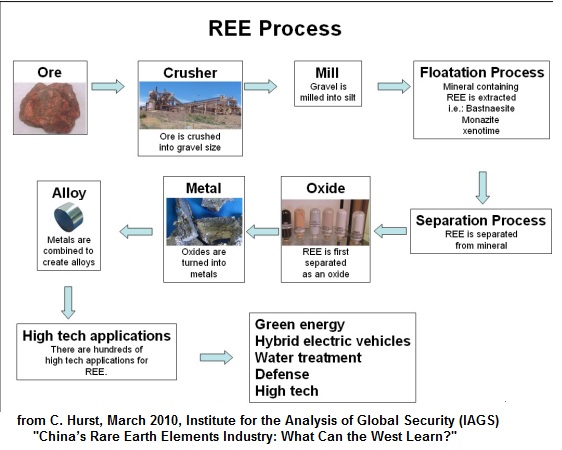
Process steps from Ore benefication to application and market through Oxide, Metal, and Alloy (Fig 4. opposite)


- Metalysis Limited exploits the The Fray-Farthing-Chen (FFC) Cambridge Process which is a new process for the extraction of metals and alloys from their solid oxides by molten salt electrolysis. (cathodic dissociation of metal oxides for electrowinning of metals)
(Fig 5) The process has a high potential. Initial step up to industrial scale-up has been encouraging with much sought after lower cost Titanium for defence and transport applications. 


Rhodia in France  (member of the  Belgian Solvay Group) is a major player in Rare Earth earth production and marketing. ( Rhodia has recently reached agreement(s) with China Rare Metals and Rare Earth Co., (Dec 12, 2011) with China Rare Metals and Rare Earth Co., Ltd. which is the wholly-owned subsidiary of CHINALCO aiming at integrating and developing the rare earth industry in China.


2 Key features of emerging trends in REE Process Metallurgical research in the UK according to Jha are :

    1. - The long history of hydrogen storage and magnetic materials research at the University of Birmingham, led by Emeritus Professor Rex Harris, has now been successfully used in recycling neodymium magnets through a Technology Strategy Board project 

READ MORE ONLINE AT INNOVATEUK.ORG


FURTHER STUDY OF RECYCLING (pdf)


    2. -   The FFC Cambridge Process has led to commercial exploitation by Metalysis Ltd., UK. The highly desirable electrochemical technique is used for further purification of the RE Oxides  RE and RE metals mixture into component metals or alloys, including the production of RE magnetic alloys. The range of Metal Oxides and Minerals is not limited to Rare Earths but can be used to process many otherwise difficult to process metals


NB.  For the student or professional reader wishing to pursue  FFC Cams process work and Electrowinning in general many papers are freely available via internet eg.


NB.    EU-France: Recycling Rare Earth Magnets
or again 

Prof Jha’s own pioneering work and approach read in rare elements from waste

“Professor Jha said that not capturing these rare earth by-products will soon no longer be an option. “Worldwide richer grades of titanium dioxide minerals are disappearing fast which means we have to process lower grades of titaniferous minerals and extract the REO as co-product and not waste them.”


Valuable rare-earth raw materials extracted from industrial waste stream  15th Dec 09


A related approach to determine valuable resources from industrial waste is underway at Durham Uni by The Geochemical Reclamation of Industrial Minerals & Elements (GRIME) research group. (reminds me of our mineral 

 Resources from Waste

A longer article entitled "Not costing the Earth - unconsidered waste materials" in 01 January 12, Materials World Magazine, cf below.

MAIN CONCLUSIONS (Prof. Jha) 

It is impossible to contemplate a future without rare earth elements. 

Although there is a research initiative within the EU that is inviting bids for basic research and development in extending knowledge, which aims to supersede the performance of REO- and metal-based devices. If successful, it will be a disruptive technology with a time-scale of market entry for such technologies of at least 10 years. 

In the meantime the new and emerging REO must progress within the EU to support industry.

Geological survey and exploration must continue within the EU and with trading partners for developing novel means of mining and mineral beneficiation. 

Deep-sea mining, which carries significant risk and expense. Such exploration carries incalculable environment cost, concerning the use of energy intensive equipment and disturbance of the sea bed that is likely to release trapped greenhouse gases.

The only viable option that remains is to continue exploring terrestrial sites for REEs, recycle, and develop new scientific understanding employing nano-science for economising the use of such sought after materials.

(Please consult the original paper for full article)


OTHER REFERENCES:

Excellent Comprehensive Website and Indepth Professional Bibliographic Resources


The Geologists too are hard at Work


They also provide advice by asking the question: “Are there alternatives to mining rare earth elements?”

From the RoyalSociety for Chemistry (RSC)  entitled  Critical Thinking


"Last October, China started building the world's biggest off-shore wind farm in Bohai Bay, a few hours from Beijing. The country is 


constructing wind farms on an unprecedented scale - surely good news given its insatiable appetite for coal. But each megawatt of 


power a wind turbine generates requires up to one tonne of rare earth permanent magnets"


LISTE OF IOM3 MEMBER ACCESS FEATURE ARTICLES ON RARE EARTH ELEMENTS. 

Critical mass - rare earth elements

01 January 12, Materials World Magazine, Feature

Ions shine on - uses of rare earth ions

01 January 12, Materials World Magazine, Feature

Rare earth resource

01 June 10, Materials World Magazine, Feature

On the surface - preparation of rare earth metals

01 January 12, Materials World Magazine, Feature

Rare earth recovery

01 August 11, Materials World Magazine, Feature

Rare on Earth? Strategically important metals and education

03 March 11, Materials World Magazine, Material matters article

Not costing the Earth - unconsidered waste materials

01 January 12, Materials World Magazine, Feature

Just how resourceful are we?

04 December 11, Materials World Magazine, News article


Sunday, 8 January 2012

Sixteen Research Roadmaps for Materials from the Directorate-General for Research Unit G3 Added- value Materials

It is widely recognized that, Materials Science and Technology are advancing fast.  Materials create added value in most products as so are of particular relevance for industry and society.
At the same time, costs must be minimised, sustainability improved, and products rendered more attractive, portable, or usable by making them smaller and lighter, improving functionality etc.
Due to their importance the EU Commission’s  Directorate-General for Research- G3 for Added- value Materials has published a guide-Research Roadmaps for Materials, in order  to focus attention of all interested parties on: the efforts engaged, to encourage further engagement and on the potential rewards for success.   

 -16 Research Road Maps 
 -10 Key Thematic Programmes (Framework programme7. FP7)
-RRM PURPOSE
-Three Key Overview Themes
-Strategies outline (Open and closed)
-Layered approach (4 layer example)
-WHY INVEST?
-11 Supporting chapters

   16 Research Road Maps, each with its specially dedicated web site has been drawn up as follows:

   2     DISC-REGENERATION-Novel biofunctional highly porous polymer scaffolds and techniques
controlling angiogenesis for the regeneration and repair of the degenerated intervertebral disc

 3     POLYSACCHARIDES -The European polysaccharide network
 4     EXCELL-Thin Fims Network of Excellence: to overcome the fragmentation of European
research in multifunctional thin films
 5     EXPERTISSUES-Novel therapeutic strategies for tissue engineering of bone
and cartilage using second generation biomimetic scaffolds LINK2 expertissues
 6     FAME & EMMI -Functionalised advanced materials and engineering of hybrids
and ceramics
Integrated design of catalytic nanomaterials for a sustainable production IDECAT logo has been corrupted!) Use ERIC Link here
 8     KMM-NoE_ Knowledge-based multicomponent materials for durable
and safe performance

 9       MAGISTER and EIMM-Magnetic scaffolds for in vivo engineering and biomimetic materials
 10     MAGMANet -Molecular approach to nanomagnets and multifunctional materials
 11     METAMORPHOSE-Metamaterials organized for radio, millimeter wave, and photonic
superlattice engineering
 12     MIND-Multi-functional and integrated piezoelectric devices
 13     NANOFUN-POLY _Nanostructured and functional polymer-based materials and
nanocomposites
 14    NANOMEMPRO-Expanding membrane macroscale applications by exploring
nanoscale material properties LINK 2
 15     ONE-P_Organic nanomaterials for electronics and photonics: design,
synthesis, characterization, processing, fabrication and applications
 16     SOFTCOMP-Soft matter composites – an approach to nanoscale functional
material

Key Thematic Programmes (FP7):
•  Theme 1      Health
•   Theme 2       Food, agriculture and fisheries, and  biotechnology
•   Theme 3       Information and communications  technologies (ICT)
•   Theme 4       Nanosciences, nanotechnologies, materials and new production  technologies (NMP)
•   Theme 5       Energy
•   Theme 6       Environment (including climate change)
•   Theme 7      Transport (including aeronautics)
•   Theme 8       Socio-economic sciences and the humanities
•   Theme 9       Space
•   Theme 10    Security
NMP underpins progress in virtually all other above mentioned Themes. The materials research
done tries to find answers to questions such as:
•   How can products and processes be improved?
•   Are there better alternative materials and process?
•   How can new materials reduce the number of components and production steps?
•   What is the impact of materials on cost, quality, safety, consumer experience and regulatory
compliance?
•   How can maximum added value be derived from materials? Can we use fewer or local materials and suppliers?
•   Which is the most sustainable material in terms of energy and primary resource consumption?
New materials can make crucial differences in many products. Multi-application materials form
a generic, horizontal, cross-cutting field with actors in many different industrial sectors.
The Nano Materials Production (NMP) theme develops both multi-application materials, and materials for targeted applications in all FP7 Thematic Areas, notably Energy, Environment, Health, ICT and Transport.
RRM PURPOSE
Risking repletion, Research Road Maps (RRM) arise from the dialogue between scientists and industrialists.
Research Road Maps (RRM) have the potential to offer great added value in guiding the activities undertaken by all stakeholders: scientists, industries, venture capitalists, research managers, etc.
In addition, if based on economic and societal needs, they can be of great value in priority-setting interactions with public administrations at national and European level.
Research road mapping involves identifying scientific and technological challenges related to the socio-economic and industrial trends expected for the coming decade(s). An analysis of existing RRMs shows that they are generally organised around three ’parameters’:

Three Key Overview Themes
•   Thematic areas/economic and societal challenges, from which common drivers for materials innovation can be derived and which have cross-sector relevance such as the FP7 Themes: Energy, Environment,…
•   Horizontal and vertical classes: horizontal classes are cross-cutting technologies e.g. modelling, metrology and standards, process technologies, manufacturing. Examples of vertical classes are structural, functional, multi-functional and bio-materials.
•   Market industry sectors e.g. aerospace, transport, healthcare, packaging, textiles, construction.

Strategies outline.

The strategies followed by roadmap producers vary from closed to open.
In closed strategies, the desired end-result is chosen and means are defined to reach this goal.
Such RRMs can easily be up-dated at regular intervals. Closed roadmaps tend to be highly
predictive constructions that are adapted to the needs of markets and activities.

Open Strategies start from a good knowledge of the state-of-the-art in a specific field of activity,
then extrapolate the developments of this activity over time. Open roadmaps may be fragile
constructions, low on prediction and usually involving accompanying blue-sky research.

A RRM could consist of 4 layers and 11 supporting chapters
First layer 
FP Theme (Health, Energy, Environment, ICT,…) supported by the NMP Programme
Second layer
Applications/systems supporting the Theme and enabled by new materials
Third layer
Materials and/or processes enabling the applications/systems
Fourth layer 
Research necessary to create the materials.

WHY INVEST?
Supporting chapters justify why scientists, industry or funding agencies should invest in these research areas.

11 Supporting chapters are listed as follows:
•   Potential application domains/lead market sector for new material scientific and technological results.
•   Context, including current bottlenecks.
•   Motivation.
•   Key performance figures (targets).
•   Activity in- and dynamics of- the field, including the patent landscape.
•   References.
•   Time-line (for Research & Development and applications).
•   Dependencies/conditions to be addressed (regulations, standardisation).
•   Prioritisation for different (regional, national, European) funding schemes.
•   Technology transfer possibilities and necessary education.
•  Conclusions and recommendations.


REFERENCES


Directorate-General for Research
Directorate G — Industrial Technologies
Unit G.3 — Value-added Materials
Ed. Anne de Baas

European Commission
EUR 24210 — Research Road Mapping in Materials 
Luxembourg: Publications Office of the European Union
2010 — 24 pp. — 17.6 x 25 cm
ISBN 978-92-79-14485-1
doi: 10.2777/87000


Tuesday, 30 March 2010

Bookmark "New method for predicting and describing how materials break" - Universal (Brittle) Materials 3D Simulation Mathematical Model?

Just for the record and future reference this rather (fairly?) wide claim to the realisation of a near "Universal" 3D Materials 3D Simulation Mathematical Model" is Published in Nature Letters under the title  "Helical crack-front instability in mixed-mode fracture". by A. J. Pons & A. Karma Notes from Nature Abstract:
-Universally unstable:
Planar crack propagation under pure tension loading (mode I) is generally stable. However, it becomes universally unstable with the superposition of a shear stress parallel to the crack front (mode III). Under this mixed-mode (I + III) loading configuration, an initially flat parent crack segments into an array of daughter cracks that rotate towards a direction of maximum tensile stress (1).
-Wide Range of Materials:
Wide range of engineering (2, 3, 4, 5, 6, 7) and geological materials (1, 8). 
The link to Nature Abstract are reproduced in references below. Ref 1)
To date at least two Science news sites have echoed the Letter to Nature with descriptions aimed at a more general public.a. ScienceDaily. b. AlphaGalileo

Short extracts from a & b.

a. "Multiscale Materials Model" ScienceDaily


"For the first time ever, a study of this new mathematical model published in Nature has managed to describe the fracture process for materials such as glass, polymers, concrete, ceramics, metals, rocks, and even certain geological fractures."

"Antonio J. Pons, of the research group on Nonlinear Dynamics, Nonlinear Optics and Lasers of the Universitat Politècnica de Catalunya (UPC)-Barcelona Tech at the Terrassa Campus, has developed a new mathematical model leading to a new law of physics that describes all the stages involved in the way materials crack, making it possible to predict how they will do so before the fracture actually occurs. This is the first time ever that this model has been used to describe objects or materials in 3D, namely all of those that occupy a volume in space and are isotropic, with a homogeneous structure. The study, published in the first week of March in Nature, has been completed in collaboration with researcher Alain Karma, professor at Northeastern University in Boston."(Ref 2)

b.  "How some materials break" from AlphaGalileo.
"A material-or, in other words, any solid object or element in our environment-can break in three different ways: from top to bottom (as in the San Andreas Fault, in California); horizontally, like a cut; or as a tear, for instance when a cable is pulled and twisted at the same time.

To set a few other examples, the fault along the Serranía del Interior mountain range in Venezuela cracks following a mixed pattern, combining the first and the third model; the crankshaft in a car motor breaks from torsion and fatigue; an adjustable wrench also breaks from fatigue; polymer materials crack like rocks; objects made of glass break along the same crack lines as geological fractures." Ref 3. below.
 
Reference
 
1. 'Helical crack-front instability in mixed-mode fracture', Nature 464, 85-89 (4 March 2010)
Antonio J. Pons(1,2) & Alain Karma(1)
1.Department of Physics and Center for Interdisciplinary Research on Complex Systems, Northeastern University, Boston, Massachusetts 02115, USA
2.Present address: Department of Physics and Nuclear Engineering, Polytechnic University of Catalonia, Terrassa, Barcelona 08222, Spain.doi:10.1038/nature08862; Received 21 January 2009; Accepted 27 January 2010

ABSTRACT
Planar crack propagation under pure tension loading (mode I) is generally stable. However, it becomes universally unstable with the superposition of a shear stress parallel to the crack front (mode III). Under this mixed-mode (I + III) loading configuration, an initially flat parent crack segments into an array of daughter cracks that rotate towards a direction of maximum tensile stress (1). This segmentation produces stepped fracture surfaces with characteristic ‘lance-shaped’ markings observed in a wide range of engineering (2, 3, 4, 5, 6, 7) and geological materials (1, 8). The origin of this instability remains poorly understood and a theory with which to predict the surface roughness scale is lacking. Here we perform large-scale simulations of mixed-mode I + III brittle fracture using a continuum phase-field method (9, 10, 11) that describes the complete three-dimensional crack-front evolution. The simulations reveal that planar crack propagation is linearly unstable against helical deformations of the crack front, which evolve nonlinearly into a segmented array of finger-shaped daughter cracks. Furthermore, during their evolution, facets gradually coarsen owing to the growth competition of daughter cracks in striking analogy with the coarsening of finger patterns observed in nonequilibrium growth phenomena(12, 13, 14). We show that the dynamically preferred unstable wavelength is governed by the balance of the destabilizing effect of far-field stresses and the stabilizing effect of cohesive forces on the process zone scale, and we derive a theoretical estimate for this scale using a new propagation law for curved cracks in three dimensions. The rotation angles of coarsened facets are also compared to theoretical predictions and available experimental data.

2. ScienceDaily

3. AlphaGalileo


Sunday, 21 March 2010

Materials and Environment- Mothers of Inventions

The above title is a declared objective of this blog appearing in first place in site header: "Materials Science and Engineering: Durable Development, Sustainable Development..."

My previous post but one published on 16 March 2010entitled,"Nanoscale, Nanomaterials: Basics - Calculate numbers of surface to volume atoms and much more." included embedding a Google book one of whose authors is by Prof. M.F. Ashby, FRS. whose work I admire greatly.

While researching work by his co-authors in particular by PJ Ferreira of The University of Texas at Austin,with the aim of commenting further on "Nano-things", I spotted not only Ferreira's abundant online publications which included work I had referenced very recently in fact by Carlton and Ferreira on the topic of Inverse Hall-Petch Relationship at the nanoscale (about 10nm)in Nanomaterials. Coincidences... While wondering how come my P.J. Ferreira became associated with Mike Ashby famous particularly for his work in Materials Selection for Engineering Applications a bit of lateral thinking led me to set aside for a moment considerations on how I intend to develop more on "Nano-thing" and focus a new on my blog's first declared focus the Title or Header support punch lines or Tags namely Durable Development, Sustainable Development..." ie. return to Mike F. Ashby.

EUREKA on two counts:

1. "Materials and the Environment – Eco-informed Material Choice" is the title of his second book published in 2009. An embeddable google preview is available for readers to preview in-depth. cf below or via on my RHS menu first entry in new list Materials and Environment.

2. A recent book review by fellow materials professionals appeared on Materials World book reviews I shall quote the reviews introduction "This book is an accessible introduction to environmental issues associated with materials selection. Anyone familiar with Professor Ashby’s other books will recognise his style and, as ever, he excels in presenting information in simple graphical form."...as I tried to convey in my earlier post on M.F.Ashby et al's other 2009 book on Nanotechnology.

The full review MW, Nov 2009, is freely available to all readers:
Materials and the Environment – Eco-informed Material Choice


RELATED POSTS

Tuesday, 11 March 2008

Metallurgy-Materials-Advanced Processes


In these web-logs, I intend to refer regularily to to the large corpus
of ever expanding member journals online made available by my life-long
The Institutes; The Iron & Steel Institute, The Institute of Metals,
The Metallurgist, all this and more today, are grouped under one Institute,

Their many available journal resources are as follows:


1. Advances in Applied Ceramics (formerly British Ceramic Transactions)
2. Appied Earth Science (IMM Transactions section B)
3. Corrosion Engineering, Science and Technology ((formerly British Corrosion Journal)
4. Energy Materials: Materials Science and Enginering for Energy Systems


5. Interdisciplinary Science Reviews

6. International Heat Treatment & Surface Engineering
7. International Materials Reviews,

8. Ironmaking & Steelmaking
9.Materials Research Innovations
10. Materials Science & Technology (My seminal paper is in the first edition Feb 1985)
11.Materials Technology: Advanced Performance Materials
12.Mineral Processing and Extractive Metallurgy (IMM Transactions section C)
13.Mining Technology (IMM Transactions section A)
14.Mineral Processing and Extractive Metallurgy Plastics, Rubber & Composites : 15.Macromolecular Engineering
16.Powder Metallurgy
17. Science & Technology of Welding & Joining
18. Surface Engineering
19. Tribology-Materials, Surfaces & Interfaces


All titles are available via Ingenta's enhanced website http://www.ingentaconnect.com/.

and to members via IOM3' members site. In many of theses matters,


I among others members, constitute your privileged access and interpretation route, feel free to get in touch.


I hope also to use my french to review work carried out under the banner of
SF2M much of which is available in english to their members.


Looking forward to a useful & successful blog experience.


High Purity Cr sources for Superalloys

Energy for th Future:Phil.Trans.A-Vol. 365, N° 1853 / April 15, 2007, curtesy The Royal Soc. London

Engineered foams and porous materials: Phil Trans A. Vol 364, N° 1838 / 06 curtesy_The R Soc. Lond