Pages

Contributors

My professional profile on Linkedin

View James Alexander's profile on LinkedIn

Where my visitors are

A380's TRENT XWB

Materials Science and Engineering, Durable Development, Recycling..

Custom Search

Blog List-Free Science and Engineering Information Resources cf also Side and Bottom menu bars

Scientific Reports - nature.com science feeds

Physical sciences : nature.com subject feeds

Materials science : nature.com subject feeds

Friday, 7 September 2012

Nano-material molecular electric conductivity is predicted to offer up to four times bulk conductivity depending on the material-molecules


The following news release from Brookhaven National Lab entitled

"Electronics Play By a New Set of Rules at the Molecular Scale"

September 2, 2012, By Aviva Hope Rutkin"
Nano-material molecular electric conductivity is predicted to offer up to four times bulk conductivity depending on the material-molecules
atomic-scale model
Click on the image to download a high-resolution version.Atomic scale visualization of the single molecule junctions formed with two equivalent pathways (left) and one pathway (right), including the bonding to the tips of two gold electrodes and a schematic of the external electrical circuit.
In a paper published in Nature Nanontechnology onSeptember 2, 2012, scientists from the U.S. Department of Energy’s (DOE) Brookhaven National Laboratory and Columbia University’s departments of Chemistry and of Applied Physics explore the laws that govern electronic conductance in molecular scale circuits.
“Everyone who has worked with basic electronic circuits knows that there are some simple rules of the road, like Ohm’s Law,” explains collaborator Mark Hybertsen, a physicist at Brookhaven’sCenter for Functional Nanomaterials (CFN). Hybertsen provided the theory to model the observed circuit behavior with the CFN’s computational tools. “For several years we have been asking fundamental questions to probe how those rules might be different if the electronic circuit is shrunk down to the scale of a single molecule.”
Conductance measures the degree to which a circuit conducts electricity. In a simple circuit, if you hook the resistors up in parallel, the electrons can flow through two different paths. In this case, the conductance of the full circuit will simply be the sum of the conductance of each resistor. 
However, in a molecular circuit, the rules that govern current flow now involve fundamental quantum mechanics. In most single-molecule circuits, the molecules do not behave like conventional resistors; instead, the electrons tunnel through the molecule. When the molecule offers two pathways in parallel, the wave-like movement of an electron can dramatically change the way conductance adds up. For several years, experts in nanotechnology have suspected—but not proven—that quantum interference effects make the conductance of a circuit with two paths up to four times higher than the conductance of a circuit with a single path.
In order to investigate these quantum mechanical effects further, the scientists needed to construct their own controllable nano-size circuits. Working with Ronald Breslow’s group at Columbia, they designed and synthesized a series of molecules to use in the experiment.
“Reliably making a circuit from a single molecule is really challenging,” says Latha Venkataraman, a Columbia Engineering Applied Physics professor whose group perfected the method used to make the molecular circuits. “Imagine trying to touch the two ends of a molecule that is only ten atoms long.”
To make the circuits, Venkataraman’s group adapted a scanning tunneling microscope (STM) apparatus to repeatedly press a sharp gold tip into another gold electrode and then pull it away. When this junction breaks, there is a moment when the gap between the two pieces of gold is a perfect fit for the molecule. Once the circuit system is set up, the conductance measurement is fast and can be repeated thousands of times to get statistically reliable data.
Using this approach, the scientists discovered that the molecules with two built-in pathways like the one visualized in the figure at right had a conductance that was greater than the sum of each arm’s conductance, although the increase was not as large as they had anticipated. In order to understand this effect better, Columbia’s Hector Vasquez worked with Hybertsen to computationally simulate the quantum mechanical transmission of an electron through each circuit.
“Both the measurements and the simulations show that the molecules with two parallel paths can have a conductance that is bigger than two times that of molecule with a single path,” said Hybertsen. “This is the signature that the quantum interference effect is playing a role.”
The group suspects that other factors, such as the nature of the molecule’s bond to the electrodes, need to be considered when calculating the conductance of a molecular circuit. They are currently looking into other central questions about molecular electronics, including how the device changes when different metals are used. 
This research was funded primarily by the National Science Foundation and the New York State Office of Science, Technology, and Academic Research. Columbia’s Rachid Skouta and Severin Schneebeli synthesized the experiment molecules with Ronald Breslow and Masha Kamanetska carried out the conductance measurements. The CFN at Brookhaven Lab is supported by the DOE’s Office of Science. ""
Refs: brough to my attention by:

Thursday, 6 September 2012

Green economies around the world? Implications of material resources use for development and the environment.


Allow me to bring to my colleagues attention and especially to my fellow members of the IOM3-Institute of Materials Minerals and Mining  the following comprehesive free report on global materials activity.

"The report addresses three main issues:
1. Patterns of material extraction, trade, consumption and resource productivity in
different world regions and countries;
2. Connections between material use and indicators of economic and social development;
3. Links between material use and selected major environmental problems, such as
carbon emissions, land use change and water use."

REFERENCE:

The Report entitled Green Economies Around the World (pdf) 

More from ZUNIA
Green economies around the world? Implications of resource use for development and the environment - Zunia.org


Wednesday, 4 July 2012

Higgs particle found_Higgs right_Hiesenberg Wrong on the God Particle!_History made and more in the making_

>


 Published on 4 Jul 2012 by CERNTV Soundbytes from the interviews to Peter Higgs, Francois Englert, Carl Hagen and Gerald Guralnik, recorded at CERN on the announcement of the latest results from ATLAS and CMS on the Higgs boson searches.

This is certainly The Materials Matter of  2012 and perhaps the most far reaching discovery of the last 50y or more.  It brings to the fore Peter Higgs' (et al.) courageous theoretical prediction  in 1964 of an undetected (and undetectable until now) particle named commonly as "Higgs' Boson" It's importance is such in terms of  human understanding of the universe and furthering of knowledge of life itself. Seeking this most elusive particle has pulled together massive investment, motivating record breaking science technology and engineering experimental performance at CERN's  LHC  (Large Hadron Collider) This discovery will certainly make the 4th of July 2012 a date on the Nobel Prize award agenda, it confirms previous approaches and points the way to further astounding progress. A material that matters indeed. 


YouTube Video Wall Link below
CERN-Best of Higgs Field Theory physicists.


MORE VIDEO LINKS FROM BBC News.

4 July 2012 Last updated at 10:48 GMT
Scientists at the Large Hadron Collider claim the discovery of a particle believed to be the long-sought Higgs boson.
Rolf Heuer, director-general of Cern, said "As a layman I would now say I think we have it."
Peter Higgs, after whom the particle is named, said it was incredible that this has happened in his lifetime.

4 July 2012 Last updated at 11:44 GMT
Professor Brian Cox reacted with delight to the news that physicists at Cern have discovered a new particle consistent with the Higgs boson.
Professor Cox told the BBC the discovery was a significant moment in the history of science and a vindication of the work carried out with the Large Hadron Collider.


13 December 2011 Last updated at 21:19 GMTHelp
Scientists at the Large Hadron Collider near Geneva have announced that they believe they have "tantalising hints" of the Higgs boson.
Martin Archer, a space physicist at Imperial College London, explains why the Higgs boson is so important.

3 July 2012 Last updated at 19:56 GMTHelp
Professor Jim Al-Khalili talks to the BBC's Pallab Ghosh about what the Higgs boson is and why confirming its existence is so important for physicists.

Monday, 14 May 2012

Learn the Fundamentals of Corrosion and Corrosion Control - from NASA's Corrosion Technology Lab.

Just received a reminder from my COMSOL news letter and blog of just how good a job the NASA's Corrosion Technology Lab. at  the Kennedy Space Center has done in summarizing the fundamentals of corrosion, describing different types of corrosion that can occur, and how they do occur, all well illustrated. Many of you may have heard of Galvanic and pitting corrosion, but what about filiform corrosion ? Thanks to COMSOL and NASA I too am a little wiser.  


Here is the full menu offered by the NASA's Corrosion Technology Lab. cf contents below:


A permanent link may be found in my side bar entitled: Materials Science and Eng. Free Online Journals-Resources

Thursday, 3 May 2012

Rare Earth Overview Supply Chain and Price: “Cradle to Grave” the Whole Life Cycle Approach


Critical mass -rare earth elements." 01 January 12, Materials World Magazine -Members only feature- by Prof. Animesh Jha’s is an excellent succinct overview of the wide and complex fields involving Rare Earth Elements,(REE’s)  Jha provides pointers and answers to many aspects in his near “cradle to grave” approach.


The issues at hand


“There are constant warnings about the risks of exhausting supply of vital resources, including the impact on our way of life. Professor Animesh Jha, from the Institute for Materials Research at the University of Leeds, UK, examines the sources of rare earth elements and the research driving their use in emerging technologies.” 


Prof. A. Jha provides pointers and answers to the following 5W’s type questions
on REE:

What they are, why they are important and to whom, what is global demand now and in the future (when), past present and future price evolution, based upon recent results and sustainability consideration in terms of resources and competition for energy, renewable energy.  


What they are: Fig1 below shows their position in the periodic table of elements (interactive memory refresher link)


Fig2 RHS. shows the relative abundance in the earths crust (not the ease of  economical exploration and mining)


MORE ADVANCED_FUNDAMENTAL STRUCTURES:- 

-Electron Configuration               Nuclear Structures.

Why they are important and to whom
                       -Motivation for Change and Innovation.

Prof. Jha focuses our attention on the essential role played by REE in a modern sustainable economy, quote: ”The REE supply chain (directly) affects three main sectors of the world economy – 1.energy, 2. health, and 3. digital and indirectly via 1 and 2 impacts upon the natural and built environments, and therefore on long-term climate change.” A powerful motor for growth is: “the world’s desire for developing cleaner and more energy efficient magnetic and electronic devices, including: displays, computer hard drives, wind turbines, fuel cells, hydrogen storage materials, efficient high-power lasers and amplifiers for materials processing and optical communication systems...” 

“Scientifically (and this is an important factor to achieving successful results) the 17 REE’s are inspiring due to their rather unusual combination of properties, manifested by their electronic and nuclear structures. This explains why they have found a multitude of applications in technology.” ( as above list)

We can safely deduce that such materials are promised an impressive long-term future due to their role in the "indispensables devices of modern life" and the coming “green technology”.

What is (cf. Fig3). Global Supply and Demand, production tonnage, evolution and projection, relative supply share and market share  )

“China is the current major player in the supply of these elements.” Indeed this situation has stimulated energetic response from the rest of the world-ROW (JOBS?) in order to avoid or at least attenuate the probable OPEP like position held by China.  


How to alleviate resource availability_Solutions.

Prof. Jha makes a clear case for finding new sources of REEs and for recycling them due to their importance in order to achieve a sustainable economy.

His analysis is succinct but all main issues are introduced, His arguments are based upon market dependence, technical, geological and mining considerations of these not so rare but unevenly distributed minerals and last but not least politico-economic issues.

Western Europe, with limited rich natural resources the REO (rare earth oxides) supply tends to focus on recycling, especially from materials at the end of life.

JOBS and Training for R and D, Minerals Exploration, Mining and Materials, Industries and Commerce.

“Although recycling REOs is an important area for growing new types of commercial activities, it is unlikely to meet the rising demands in the energy and digital sectors”. (I translate this as a source of much needed SUSTAINABLE JOBS. 

“If Europe focuses on research and development for cleaner technology based on REEs, there might be a joint opportunity to work with major mining companies outside China (95% of REE mineral sources) for creating healthy competition and industry.” 


NB.
I guess there is an excellent opportunity for Jobs here– I recently learned that an old university classmate, instead of taking a well earned retirement, decided to take a position with as Senior Project Manager with a Canadian Rare Earth Exploration Company member of The Rare Earth Industry and Technology Association, RITA,based in Colarado,USA.

The EU and naturally the UK situation are focused upon:

-Critical materials for the energy and transport sectors (wind turbines, hybrid cars, hydrogen storage, catalytic converters in auto-motives and fuel cell devices, and solid-state lighting are listed

-Need to create research and development capabilities and new opportunities for REE business is strongly recommended by UK’s Chemistry, Materials, and Environmental Sustainability Knowledge Transfer Networks (KTN-Innovation Strategy) KTN-Innovation Strategy Board_Free sign to browse and contribute:
       

EXTRACTIVE AND PROCESS METALLURGY 

Development of research and development capability in the UK and the rest of western Europe has already started.

REE Companies (UK)

Companies Processing Industrially RE Minerals UK
- Less Common Metals Company in UK is a major rare earth metal producer, now part of  Great Western Minerals Group Ltd.


Products    

Processes 


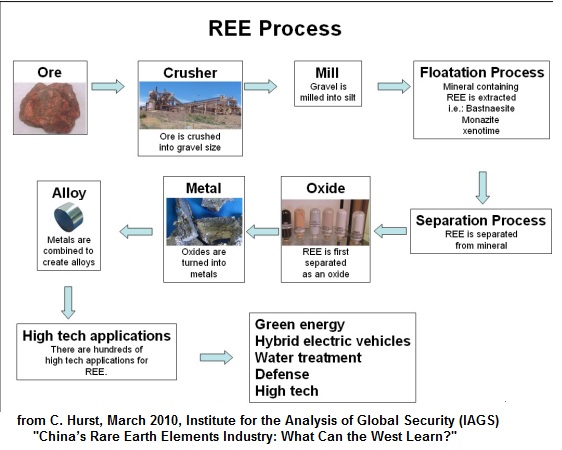
Process steps from Ore benefication to application and market through Oxide, Metal, and Alloy (Fig 4. opposite)


- Metalysis Limited exploits the The Fray-Farthing-Chen (FFC) Cambridge Process which is a new process for the extraction of metals and alloys from their solid oxides by molten salt electrolysis. (cathodic dissociation of metal oxides for electrowinning of metals)
(Fig 5) The process has a high potential. Initial step up to industrial scale-up has been encouraging with much sought after lower cost Titanium for defence and transport applications. 


Rhodia in France  (member of the  Belgian Solvay Group) is a major player in Rare Earth earth production and marketing. ( Rhodia has recently reached agreement(s) with China Rare Metals and Rare Earth Co., (Dec 12, 2011) with China Rare Metals and Rare Earth Co., Ltd. which is the wholly-owned subsidiary of CHINALCO aiming at integrating and developing the rare earth industry in China.


2 Key features of emerging trends in REE Process Metallurgical research in the UK according to Jha are :

    1. - The long history of hydrogen storage and magnetic materials research at the University of Birmingham, led by Emeritus Professor Rex Harris, has now been successfully used in recycling neodymium magnets through a Technology Strategy Board project 

READ MORE ONLINE AT INNOVATEUK.ORG


FURTHER STUDY OF RECYCLING (pdf)


    2. -   The FFC Cambridge Process has led to commercial exploitation by Metalysis Ltd., UK. The highly desirable electrochemical technique is used for further purification of the RE Oxides  RE and RE metals mixture into component metals or alloys, including the production of RE magnetic alloys. The range of Metal Oxides and Minerals is not limited to Rare Earths but can be used to process many otherwise difficult to process metals


NB.  For the student or professional reader wishing to pursue  FFC Cams process work and Electrowinning in general many papers are freely available via internet eg.


NB.    EU-France: Recycling Rare Earth Magnets
or again 

Prof Jha’s own pioneering work and approach read in rare elements from waste

“Professor Jha said that not capturing these rare earth by-products will soon no longer be an option. “Worldwide richer grades of titanium dioxide minerals are disappearing fast which means we have to process lower grades of titaniferous minerals and extract the REO as co-product and not waste them.”


Valuable rare-earth raw materials extracted from industrial waste stream  15th Dec 09


A related approach to determine valuable resources from industrial waste is underway at Durham Uni by The Geochemical Reclamation of Industrial Minerals & Elements (GRIME) research group. (reminds me of our mineral 

 Resources from Waste

A longer article entitled "Not costing the Earth - unconsidered waste materials" in 01 January 12, Materials World Magazine, cf below.

MAIN CONCLUSIONS (Prof. Jha) 

It is impossible to contemplate a future without rare earth elements. 

Although there is a research initiative within the EU that is inviting bids for basic research and development in extending knowledge, which aims to supersede the performance of REO- and metal-based devices. If successful, it will be a disruptive technology with a time-scale of market entry for such technologies of at least 10 years. 

In the meantime the new and emerging REO must progress within the EU to support industry.

Geological survey and exploration must continue within the EU and with trading partners for developing novel means of mining and mineral beneficiation. 

Deep-sea mining, which carries significant risk and expense. Such exploration carries incalculable environment cost, concerning the use of energy intensive equipment and disturbance of the sea bed that is likely to release trapped greenhouse gases.

The only viable option that remains is to continue exploring terrestrial sites for REEs, recycle, and develop new scientific understanding employing nano-science for economising the use of such sought after materials.

(Please consult the original paper for full article)


OTHER REFERENCES:

Excellent Comprehensive Website and Indepth Professional Bibliographic Resources


The Geologists too are hard at Work


They also provide advice by asking the question: “Are there alternatives to mining rare earth elements?”

From the RoyalSociety for Chemistry (RSC)  entitled  Critical Thinking


"Last October, China started building the world's biggest off-shore wind farm in Bohai Bay, a few hours from Beijing. The country is 


constructing wind farms on an unprecedented scale - surely good news given its insatiable appetite for coal. But each megawatt of 


power a wind turbine generates requires up to one tonne of rare earth permanent magnets"


LISTE OF IOM3 MEMBER ACCESS FEATURE ARTICLES ON RARE EARTH ELEMENTS. 

Critical mass - rare earth elements

01 January 12, Materials World Magazine, Feature

Ions shine on - uses of rare earth ions

01 January 12, Materials World Magazine, Feature

Rare earth resource

01 June 10, Materials World Magazine, Feature

On the surface - preparation of rare earth metals

01 January 12, Materials World Magazine, Feature

Rare earth recovery

01 August 11, Materials World Magazine, Feature

Rare on Earth? Strategically important metals and education

03 March 11, Materials World Magazine, Material matters article

Not costing the Earth - unconsidered waste materials

01 January 12, Materials World Magazine, Feature

Just how resourceful are we?

04 December 11, Materials World Magazine, News article


High Purity Cr sources for Superalloys

Energy for th Future:Phil.Trans.A-Vol. 365, N° 1853 / April 15, 2007, curtesy The Royal Soc. London

Engineered foams and porous materials: Phil Trans A. Vol 364, N° 1838 / 06 curtesy_The R Soc. Lond